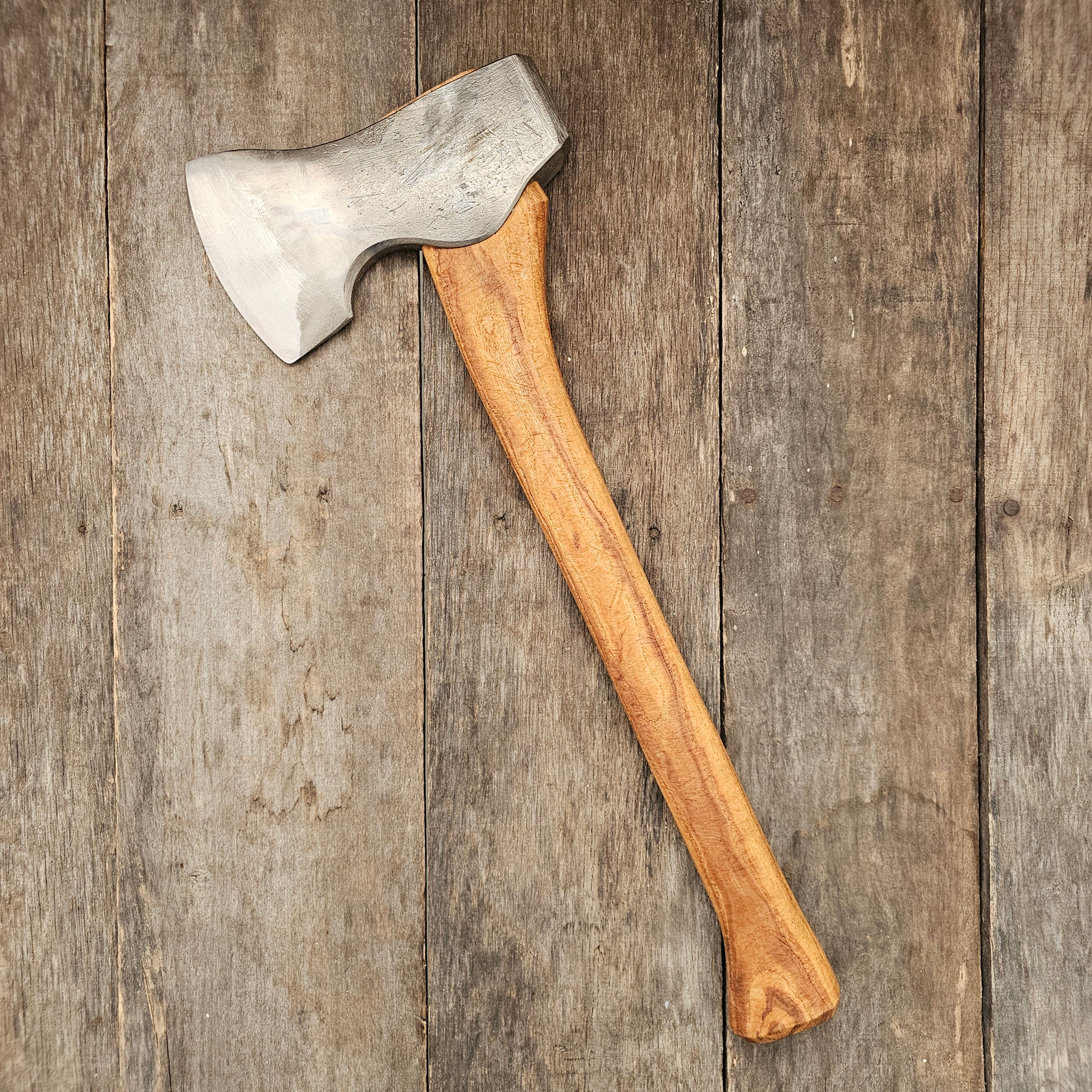
Brand/Manufacturer of axe head: Kelly True Temper Flint Edge
Handle Construction/Material: hand split and air dried ash, oval with scratched finish
Overall Length: 18.5 inches
Head Length: 7 inches
Blade/Bit Length: 4.25 inches
Overall Weight: 3 pounds 3 ounces
Head Weight: approx. 2.5 pounds
Approx. Grind Angle (near edge): 19 °
About this axe:
•Good all-rounder for chopping, splitting, and hewing
•Intended primarily for one-handed use, but may be too heavy for some individuals
A full-size 3.5-4lb felling axe head on an 18-20" handle, modified to reduce weight and tuned to hew on a stump, is what I call a Heavy Craft hatchet. In my years of processing many hundreds of rough split spoon and tool handle blanks to uniform and rectangular with wedges, axe, and drawknife, this style of hatchet is what evolved to suit my needs. A symmetrical, very slightly convex grind over the whole cheek allows for good bite in hewing without glancing, but also allows for great performance in general, i.e. chopping and splitting. Finger relief behind the beard facilitates push cutting, prying off bark, etc.
A well-fitted, modest handmade leather sheath protected with mink oil is included.
***
As an avid axe user myself, I build axes to be working tools using simple and unpretentious craftsmanship. I do not and will not pander to market forces, so trendy gimmicks and frivolous design features are avoided entirely. I strive to give every axe a blade geometry that performs extremely well but is also easy to maintain. In addition, having had my hands injured by axes with poorly designed handles, extreme attention is paid to comfort and ergonomics. Most of my handles will be intentionally roughened rather than scraped or sanded smooth, because some texture is essential for maintaining positive control and avoiding grip fatigue. Whether made from logs I split myself or commercially prepared lumber, the grain of every axe handle is carefully assessed to run as true as possible in all directions (unless explicitly noted otherwise).
Because every axe is given thorough real world testing to ensure performance and durability, your axe may arrive with minor smudges and scuffs from contact with wood, but it will definitely arrive razor sharp and ready for work. My tool handles are finished with additive-free, pure raw linseed oil.
This video shows typical tasks and performance in oak for Heavy Craft hatchets I offer.
Heavy Craft Hatchet -- Kelly True Temper Flint Edge
Axes are perhaps the most abused of hand tools, and they are often used in ways that are unsafe. I recommend everyone spend time learning and practicing safe and proper usage. Every effort is made to select strong wood with true grain for my handles, and to do the safest and most secure installation job possible. Nevertheless, every axe should inspected before, during, and after every use. Even adhering to the most stringent safety practices, accidents and material failures can happen with any stiking tool. The user must acknowledge and accept liability for this inherent risk. That being said, if one of my axes does not meet the customer's expectations or fails in any way that is not due to mistreatment by the user, I will do everything possible to make it right -- including repair or replacement as well as paying shipping both ways.
•To the extent possible, keep your axe away from moisture. While incidental exposure to rain or snow often can't be avoided and is usually not a concern, be sure to wipe your axe dry as soon as possible after use. Heavy moisture exposure causes wood to swell and then shrink as it dries back out, and this can result in an axe head coming loose. Never put the sheath on if either the sheath or the axe head is wet, as this will cause rusting of the bit.
•To the extent possible, keep your axe away from heat, as this causes excessive drying and shrinkage of the handle and can cause the head to come loose. Never store your axe in direct proximity to a campfire, wood stove, or heat register, or in the cab of a vehicle that is parked in the sun, for instance.
•Periodically apply a light coat of linseed oil, or an oil/wax mixture to your entire axe, including the head, and especially the endgrain areas of the handle. I recommend raw linseed oil rather than boiled for two reasons. First, all commercially formulated boiled linseed oil contains toxic additives to accelerate drying. Second, the longer drying time of raw linseed oil not only allows it to soak deeper into the wood before it polymerizes, but makes any excess much easier to wipe off. Let the oil soak in for several hours and then wipe clean. SAFETY NOTE: Be sure to dispose of any oil-soaked cloths properly as they are a serious spontaneous cumbustion hazard!
•I strongly recommend sharpening with a file. Most axes will take a hair-popping, razor edge with nothing but a fine toothed single cut file. A more aggressive double cut file can be used to remove any dings or if significant reprofiling is ever needed. Try to maintain the basic bit geometry. With repeated sharpenings, axes will tend to become too convex at the edge, which results in significantly reduced performance and can be dangerous because it increases the chance of glancing blows. See the instructional videos for a detailed demonstration of sharpening with a file.
•In order to protect the bit of you axe, always split on a stump and be sure its surface is free of grit. Splitting or chopping wood directly on the ground will rapidly dull any axe and is likely to cause serious or even irreparable damage to the edge.
•Never swing your axe with excessive force. This is not only dangerous of course, but it dramatically increases the risk of damaging the axe due to overstrike or hitting the ground. Learn good technique and then focus on accuracy and let the tool do the work.
